
4NCL Easter Congress
by Yuri Krylov

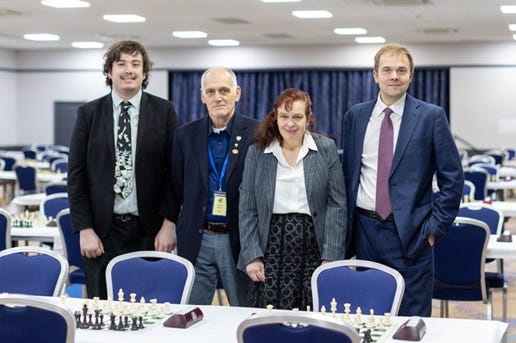
My first experience of the 4NCL Easter Congress came with expectations already firmly set. Having watched Michael Green speak about the event on the ECF YouTube channel with something approaching evangelical enthusiasm, I arrived in Daventry for the 4NCL Easter Congress expecting to see a lot of familiar faces. The congress runs alongside the invitational IM and GM norm tournaments, creating an interesting contrast between open Swiss competition and the all-play-all events. This year’s congress drew 162 players across three sections, with the Under 2000 being particularly well-populated. There was a strong junior presence throughout, many clearly comfortable in the environment, some perched on booster seats that gave the impression of a new generation quite literally being elevated into the game. It looked like many were inspired by our new British number 1 female player, who still uses her booster.
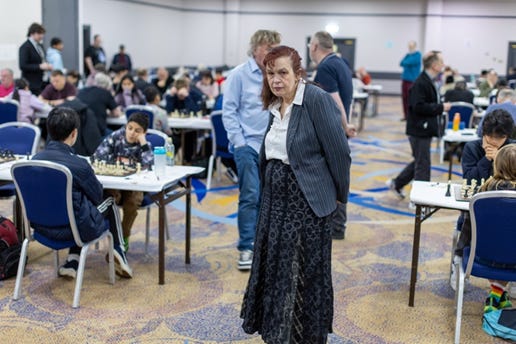
I was at the congress as an arbiter, working towards a FIDE arbiter norm under the close scrutiny of two experienced IAs – Jo Wildman and Lance Leslie-Smith. Having qualified as a Level 1 arbiter in 2024, most of my experience to date has been in rapidplay and blitz formats, where faster play invites a flurry of displacements and illegal moves. In faster formats disputes are often resolved through memory and reconstruction. In standardplay chess there is a written record, and that changes the nature of arbitration. Illegal moves are rare, but when they do occur the game can always be reconstructed to the last legal position. At this congress there was a notable incident involving a player promoting a pawn to a piece of the wrong colour, contrary to the laws of chess. The player’s instinct was to correct it informally and continue, but the move had to be ruled illegal and handled accordingly. It was a useful reminder that even in seemingly straightforward situations arbiters are there to apply the rules consistently rather than negotiate outcomes. I also had to explain the en passant rule to a younger player, deal with touch-move issues and clocks that weren’t started, but nothing out of the ordinary. There was also a mobile phone incident in the final round – always a frustrating situation. With players checking out of the hotel, bags come into the playing hall, and it only takes one forgotten device to make a noise at the wrong moment. The regulations here are uncompromising: any player in possession of a switched-on device must be defaulted immediately. It’s not a decision any arbiter likes to make, but it is one that has to be enforced.
The dynamics of the Swiss system also became more apparent as the rounds progressed. In the first two rounds there were a number of early finishes, as rating differences were reflected in the pairings. By round 3, however, the field had largely sorted itself. Games became longer, more balanced, and far more resistant to quick resolution. It was common to see positions still being contested deep into the third or fourth hour, with only a handful of results recorded in the early stages of each round. In contrast the IM and GM norm events, which were run and organised by Lance, followed a very different pattern. With a closed field and specific norm requirements the approach to risk was more pragmatic. There were games that concluded very quickly – some effectively agreeing terms after minimal play – reflecting the players’ assessment of tournament strategy rather than any lack of ambition. Where the congress games were often long and exploratory, the norm games tended to be more controlled and calculated in their approach. The tournament did produce a GM norm for Marcus Harvey, who had a huge stroke of luck in the penultimate round when Norwegian GM Frode Olav Olsen Urkedal, who had been better much better earlier on, fatally overpressed when a pawn up in a bishop against knight ending long after the hall was empty of all other players. Paired against IM Jack Rudd in the final round, Marcus knew that Jack would not be an easy opponent, as the speed at which Jack moves can throw off a lot of players; and with Jack completely dismantling 2573-rated Urkedal in round 2, there was an agreement among the arbiters that Jack can play as a 3000 or a 1500 on any given day. Luckily it did go Marcus’s way in a 25-move Nimzo-Indian with White, and he was chuffed to bits to get his first GM norm.
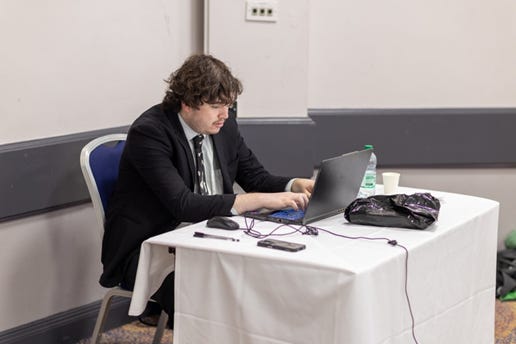
Around 40 boards were equipped for live broadcasting under the supervision of Richard Buxton, providing coverage of the all-play-alls, the Open and the leading games in the U2000 section. However, many games were played on traditional sets, which meant that post-round work involved manually entering games into databases. This process highlighted another practical challenge: the variability of handwriting on scoresheets. Moves were occasionally ambiguous, squares misidentified, and piece designations unclear. Reconstructing games required not just transcription but deciphering – more akin to chess detective work than data entry – piecing together fragments of notation, cross-checking move orders, and ensuring everything made sense with the position on the board rather than relying solely on what had been written down.
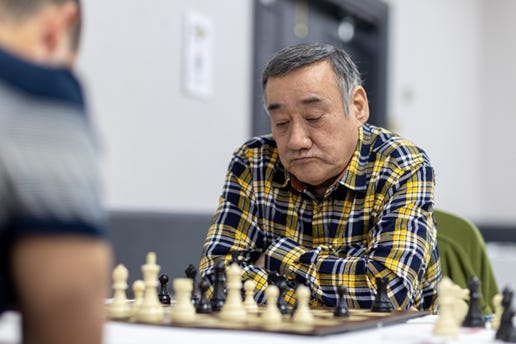
As the congress progressed I noticed an increase in blunders, as seven rounds of standardplay chess in three days is not an easy undertaking. From a chess perspective there was a wide range of instructive moments across the event. In the Open section Mark Hebden was a constant presence on the top board. In his round 2 game against John Potter he demonstrated the value of experience and preparation. Having recently faced the Vienna Gambit against the same opponent, Hebden came prepared to steer the game into territory he understood well. The critical moment came with a well-judged exchange sacrifice, giving up a rook for bishop and pawn in return for long-term structural compensation. As the game simplified Hebden’s queenside pawn majority became decisive, with connected passed pawns advancing methodically and proving impossible to stop; and he went on to win both of his games on Sunday against Oleg Verbitsky and Zac Norris. He did, however, lose in round 6 to the eventual winner of the Open, Ieysaa Bin-Suhayl. Ieysaa secured first place with a quick 18-move draw against Maksym Larchikov in the final round. Speaking afterwards, he noted that this was his second consecutive 4NCL Easter Congress victory, and said he was already looking forward to returning for the league’s final weekend over the May bank holiday.
Endgames also provided several notable examples across the sections. In the Under 2000 section James Kearney showed excellent technique in converting a bishop and knight against a lone king – an endgame that is often mishandled at club level. Despite the inherent difficulty of coordinating the pieces he executed the mating procedure cleanly, with only a few moves remaining before the 50-move rule would have intervened. In contrast, young Aden Kennedy was involved in a rook and bishop versus rook endgame that stretched to 136 moves. Despite persistent efforts to create winning chances, the theoretical draw held up. In the U2000 section Mohammad Mozaffari went into the final round with 5½, closely followed by three players on 5. This section proved the longest to decide; although the second-board game ended as a draw after 3½ hours of play, Mohammad was grinding away in a rook, knight and two opposite connected flank pawns each ending against Jacob Watson where anything looked like it could happen, with Jacob was significantly up on time (21 minutes to 3). At 7 pm – four hours into the round - Jacob promoted to a queen on move 62, but with White having two advanced connected passed pawns and a knight the position still looked complicated despite the engine showing Black as +5. The game swung wildly as both players made various blunders in extreme time pressure, Jacob making the last one by resigning in a drawn position. The last game to finish, and a very dramatic one at that! I have not seen such emotions for a very long time at a chess tournament.
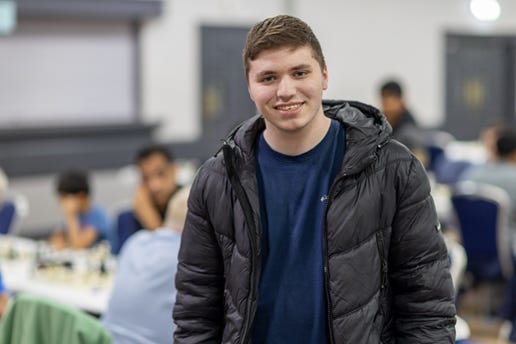
In the Under 1700 section Sam Smylie’s 12-move draw in the last round was enough to seal the top spot as he came home a whole point clear of the next five players.
The evening blitz event provided a sharp contrast to the measured pace of the classical rounds. Here errors were more frequent, and often more dramatic. Illegal moves appeared, including another incorrect promotion, and time pressure led to significant swings in evaluation. On board 1 GM Vojtěch Plát found himself in a winning position against GM Szymon Gumularz, only to see the game slip rapidly out of control within a couple of moves. The reversal from +4.7 to -4.7 was enough to prompt an immediate withdrawal from the event, a reminder of how unforgiving blitz chess can be at any level.
The overall atmosphere of the congress remained remarkably consistent. There was no attempt to introduce additional entertainment or external engagement - no commentary, no side events, no distractions beyond the games themselves. Compared to more modern, media-focused chess events, the setting was minimalistic.
And yet it worked.
Players remained deeply focused, the rounds progressed smoothly, and the lack of external stimulus did not appear to detract from the experience. If anything, it reinforced the central appeal of classical chess: the opportunity to engage fully with the game without interruption.
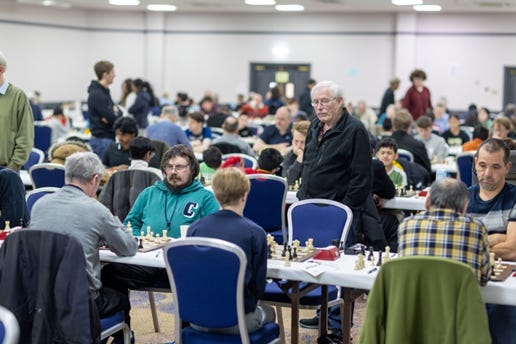
This raises an interesting question about the direction of tournament chess. There is a growing trend towards making events more accessible and entertaining, particularly for the vastly untapped online audiences. Faster formats, live commentary, and interactive elements all have their place. But the Easter Congress demonstrates that there is still a strong demand for traditional formats, where the emphasis is entirely on the quality of play. Ultimately the expectations set beforehand were met, but not in the way I had anticipated. The strength of the event was not in any single feature, but in the coherence of the whole - a well-structured tournament, a committed field of players, and an environment that allowed the game itself to take centre stage.
It turns out that sometimes that is more than enough.